Orecchio: Minimal Pairs ESL
Minimal pairs for English learners, l/r and ship/sheep heard in ten voices
Join the tester group first, then opt in and install the app from Google Play.
Screenshots
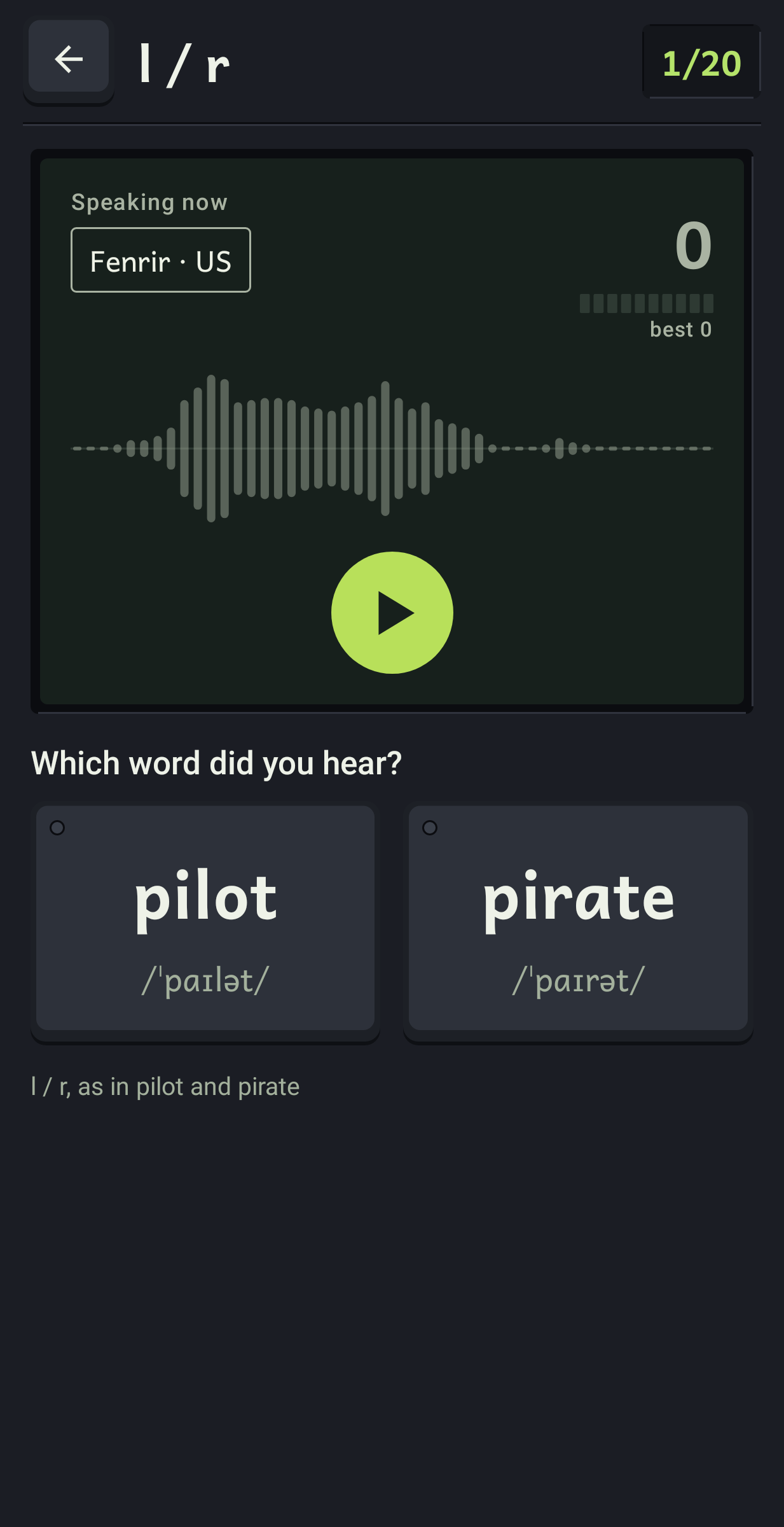
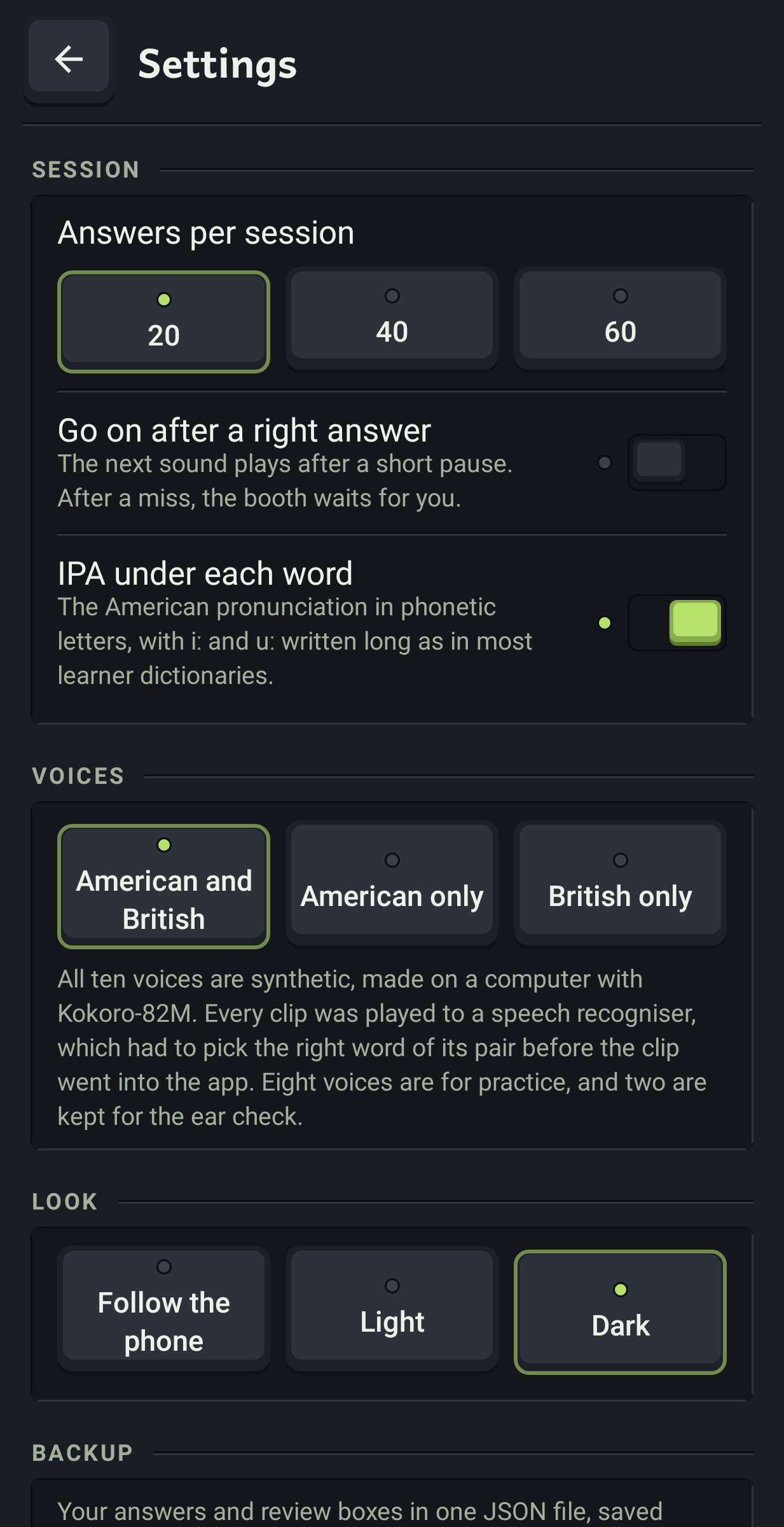
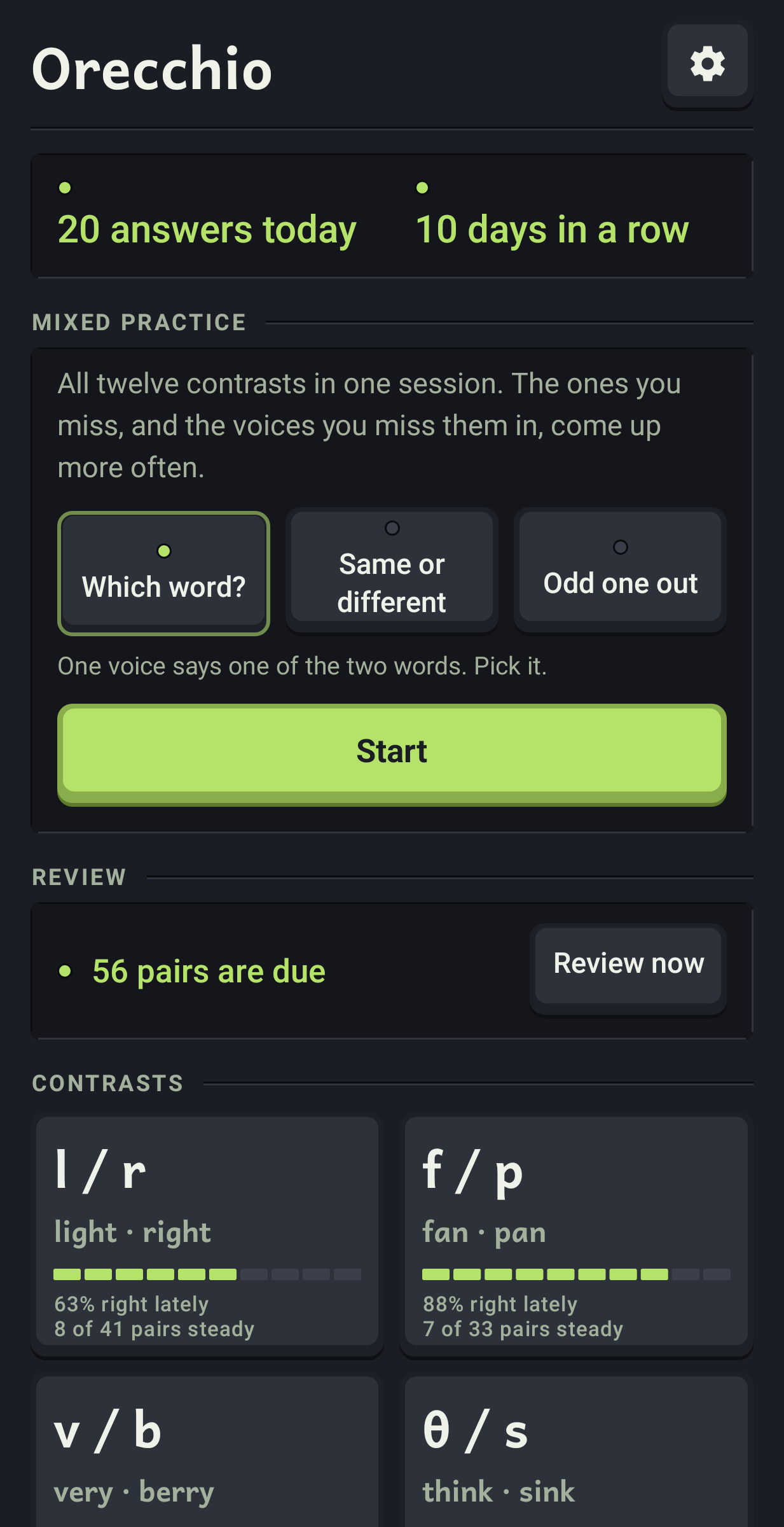
Orecchio is Italian for ear. The app trains one thing, which is hearing the English sounds that your first language hears as one. Light or right? Ship or sheep? A voice says a word, you pick it, and you know at once.
"Listen carefully" rarely helps an ear that hears light and right as the same word. Studies of high-variability phonetic training describe what does help. They use many different voices, a choice between two words, and the answer right away. That is the whole app, and it runs offline.
How a session goes
1. A voice says one word. Two cards show the two words it could be.
2. You tap one. The card gets a tick or a cross, and the line under it says which word it was and who said it.
3. Hear both words back to back, or in another voice, then go on.
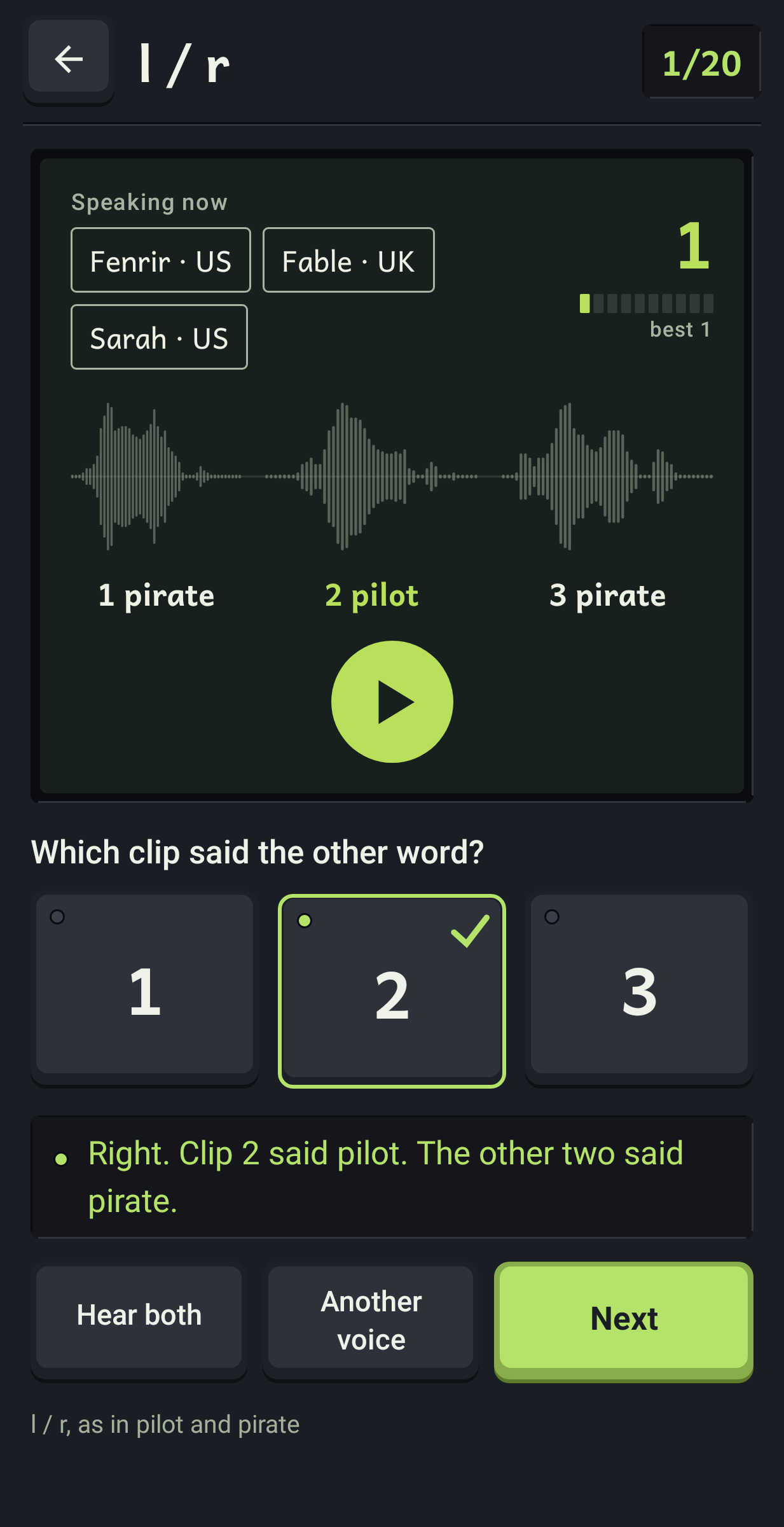
A session is 20, 40 or 60 answers. Two more drills use the same pairs. In Same or different, two voices each say a word and you decide if it was the same word. In Odd one out, three clips play and you find the one that said the other word.
Twelve contrasts, about 300 word pairs
l and r (light, right), f and p (fan, pan), v and b (vote, boat), θ and s (think, sink), ð and d (they, day), z and dʒ (zest, jest), s and ʃ (see, she), iː and ɪ (sheep, ship), uː and ʊ (pool, pull), æ and ɛ (bad, bed), a final consonant that is there or not (see, seed), and the extra vowel that turns blow into below. Each contrast has a short note on how the two sounds are made and what to listen for, and every word shows its IPA.
Ten voices, and every clip was checked
The voices are synthetic, American and British, women and men, made with the open Kokoro-82M model. Before a clip went into the app, a speech recogniser heard it and had to choose between the word and its partner. A clip it got wrong was left out of that pair. Every pair was also checked against two pronouncing dictionaries, so the two words really differ in the one sound named. Eight voices are for practice, and two are kept for the ear check.
What adapts to you
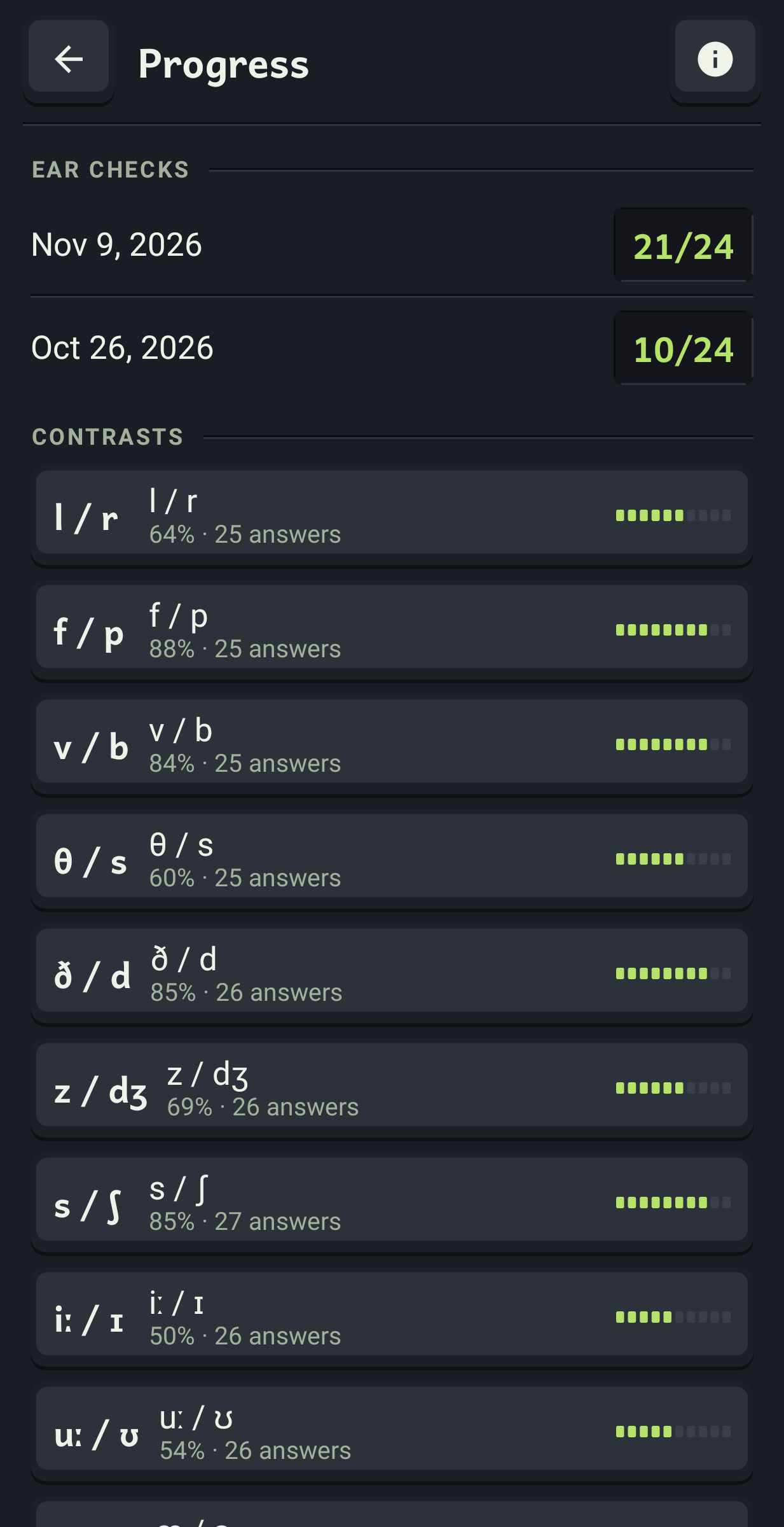
The pairs and voices you miss come back more often. A pair you answer right returns after 1, 3, 7, 16 and then 35 days, so the review list stays short. The progress page has a contrast map that splits every contrast by where the sounds differ in the word (start, middle, end) and shades each square by your hit rate. Each contrast also shows your results voice by voice.
The ear check
24 words that never come up in practice, said by the two voices you never practise with, with no answers until the end. Take it on the first day and again two weeks later, and compare.
Privacy
There is no microphone permission and no internet permission. Everything the app plays is inside it, and your answers stay on your phone. A backup file you save yourself can carry them to a new phone, and a restore can be undone.
Questions
Does it check my pronunciation? No, it trains listening only. Hearing a difference usually comes before saying it.
Why synthetic voices? They let one person build ten voices for every word. The recogniser check above is there because a synthetic voice can blur a sound.
Who is it for? Teenagers and adults learning English, from beginners who know the words to advanced learners who still mix up a few sounds.